%20(1)%20(1).png)
Read more
UAV Helicopter Operations in GNSS-Denied Environments
When satellites go dark, Alpha's UAV helicopters keep ISR on track using advanced technology for GNSS-denied environments.
Version 1.0.0
January 2026
Published

The conflict in Ukraine has redefined modern drone warfare. Small tactical unmanned aerial vehicles (UAVs) that once operated with complete reliance on satellite positioning now face a more hostile electromagnetic environment. Russia and Ukraine have both deployed sophisticated electronic warfare (EW) systems, disrupting Global Navigation Satellite System (GNSS) signals.
The result is an aerial operating environment where positioning, navigation, and timing (PNT) are no longer guaranteed. The disruption of radio frequency-based communications has even forced the use of fiber-optics to provide cost-effective, secure and resilient connectivity for both command networks and UAV operations.
Today, electronic jamming and spoofing have become standard defensive measures. Modern Counter-UAS (C-UAS) systems can saturate airspace with interference, degrade positional accuracy, or even mislead unmanned platforms into navigating along false tracks.
These developments have underscored two fundamental truths:
GNSS is vulnerable. Any system relying solely on satellite-based navigation is susceptible to disruption by adversaries with counter-UAV capabilities.
Persistent Surveillance is dependent on fully resilient autonomy. For UAVs to fulfill their missions they must maintain operational integrity in the absence of GNSS.
For military UAVs like the Alpha A900, tasked with intelligence, surveillance, and reconnaissance (ISR) missions, this GNSS-denied environment poses a fundamental question: how can unmanned systems operate when the sky becomes contested?
The Autopilot - Core technology for autonomous operations
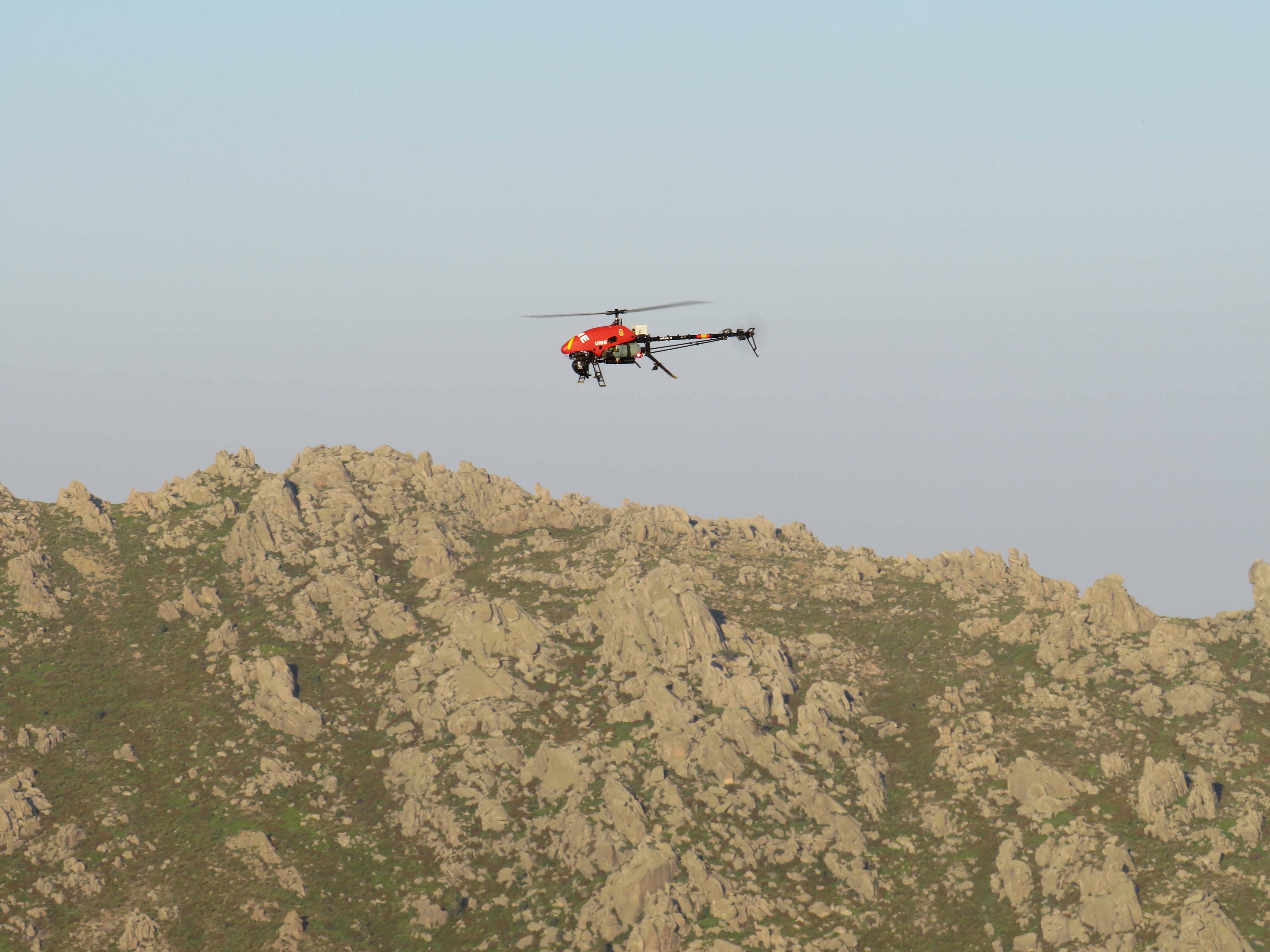
Rotary-wing UAVs such as Alpha's helicopter platform occupy a critical niche in military surveillance operations. They can hover, operate at low altitude, and launch from confined spaces such as ship decks or forward operating bases, capabilities that fixed-wing drones often lack.
Like all UAV platforms, unmanned helicopters are also vulnerable to GNSS denial. The need for robust, embedded non-GNSS navigation capabilities is therefore paramount.
At the heart of Alpha's unmanned helicopters is the VECTOR-600 autopilot from UAV Navigation. This system was designed from the ground up for military-grade operations. The autopilot is built with fully redundant architecture, incorporating multiple layers of physical and logical safeguards. This means that even if one or more sensors fail, the autopilot continues to function. By combining data from inertial, barometric, magnetic, and visual sensors, we can maintain precise control of the aircraft's attitude and positioning.
Seeing When Satellites Go Dark
While the autopilot provides core stability, it's the Visual Navigation System that enables our helicopters to operate effectively in fully GNSS-denied situations. The Visual Navigation Systems relies on a combination of Visual Odometry (VO) and Pattern Recognition (PR) to navigate in the absence of GNSS.
Using an onboard camera, the system continuously captures images of the surrounding environment, identifying and tracking natural or man-made landmarks. By comparing successive images, it calculates both motion and position relative to these reference points, effectively "seeing" its way through the landscape.
To maintain long-term accuracy, the system builds a dynamic map during flight. This evolving map allows the helicopter to correct the positional drift that can occur when a UAV relies solely on inertial navigation. By anchoring its navigation to real visual references, the system ensures that positional errors do not accumulate over time, even on extended 4 hour surveillance missions.
All of this data is seamlessly integrated through sensor fusion, delivering continuous positional updates to the Flight Control Computer (FCC). This combination of data inputs allows the UAV to maintain stable flight, adhere to planned waypoints, and carry out surveillance tasks reliably, even in environments where GNSS signals are heavily degraded or completely denied.
Reliable ISR Operations When GNSS Fails
Modern ISR missions often require our UAV helicopters to loiter for hours, follow complex flight plans, and relay real-time data to command centers. In GNSS-denied situations, Alpha's proven onboard navigation technology provides several operational benefits:
Mission Continuity: Our helicopters can complete their planned flight paths despite jamming, guaranteeing consistent surveillance coverage.
Reduced Risk: Alpha's unmanned platforms can return autonomously even after prolonged GNSS loss, dramatically decreasing the likelihood of mission failure or UAV loss.
Operator Confidence: Crews can focus on the surveillance mission objectives rather than emergency interventions caused by navigational failure.
Advancing UAV Autonomy Beyond GNSS
As ever-more sophisticated C-UAS systems are developed, the demand for surveillance UAVs capable of operating independently of GNSS will continue to grow. This evolution will drive deeper integration of machine vision and AI, enabling drones to interpret their surroundings for both navigation and target recognition.
Greater reliance on multiple sensors, where visual, inertial, radar, and even magnetic references combine for redundancy. Higher levels of mission autonomy, allowing UAVs to make limited tactical decisions when signals are lost.
Staying On Track in Contested Domains
In today's military surveillance environments UAV mission success depends on the ability to navigate accurately without satellite signals.
By integrating the latest autopilot and visual navigation technologies, Alpha's rotary-wing UAVs can maintain their operational effectiveness in GNSS-denied conditions. Our onboard technologies guarantee situational awareness, and give operators complete confidence in their unmanned assets even in the most contested theatres.

.jpg)
.svg)


.png)
